
Services
Sugaring in Easley, SC
Three ingredients — sugar, lemon juice and water — worked by hand at body temperature. No strips, no rosin, no hot wax. Here is how it actually works, what the evidence supports, and what it does not.
- Three ingredients
- Sugar, lemon juice, waterRinses off with plain warm water
- Body temperature
- No heating requiredThermal burns are not a concern with the hand method
- No rosin
- Nothing from pine or spruceDermatology references list it as an alternative for people who react to wax
Sugaring in Easley, SC
Most sugaring pages you will read say the same six things, none of them sourced. We went and checked. Some of the popular claims hold up beautifully. Several do not, and we would rather tell you which is which than sell you a story.
The honest headline
There is no clinical trial comparing sugaring to waxing — not on pain, not on ingrown hairs, not on regrowth. The medical literature on sugaring consists of two short descriptive papers and a handful of passing mentions. So when you read “sugaring causes 70% fewer ingrown hairs,” that number came from somewhere, and it was not a study.
What follows is what we can actually stand behind, with the sources listed at the bottom of this page.
What sugar paste actually is
Sugar, lemon juice and water. That is the whole recipe, and it is confirmed independently by DermNet, by a 2016 JAMA Dermatology piece and by a 2021 review in Skin Therapy Letter. Commercial pastes sometimes add cornstarch, honey or guar gum; the paste we use in the studio is the three-ingredient kind.
Why the lemon juice is there — and it is not for scent
This is the part almost nobody writes correctly. The acid in lemon juice, combined with heat, splits table sugar (sucrose) into its two component sugars, glucose and fructose. Chemists call the result invert sugar. Invert sugar resists crystallising and holds onto water.
That is exactly what you want in a paste you are going to warm in your hands and stretch across skin: it stays smooth and pliable instead of turning grainy like a hard candy. The lemon is doing chemistry, not perfume.
Why it rinses off with water
Sugars dissolve in water. Depilatory wax does not — it is built on beeswax and rosin, which is why wax residue generally needs an oil-based or solvent remover. Sugar paste comes off in the shower.
The one advantage with real evidence behind it: no rosin
Rosin — also called colophony — is a resin from pine or spruce, and it is what makes depilatory wax sticky. It is also a recognised contact allergen. DermNet lists depilatory wax among the exposure sources for rosin allergy, notes that the resulting dermatitis typically appears one to three days after contact, and is blunt about the treatment: avoidance is the only long-term option, and there is no way to desensitise someone to rosin. There are multiple published case reports of allergic contact dermatitis from colophony in hair-removal wax.
Sugar paste contains no rosin. That is why DermNet lists sugaring as a suitable alternative for people who are sensitive to wax. Of all the reasons to choose sugaring, this is the one with the firmest ground under it — and it is specific rather than vague.
How the technique works
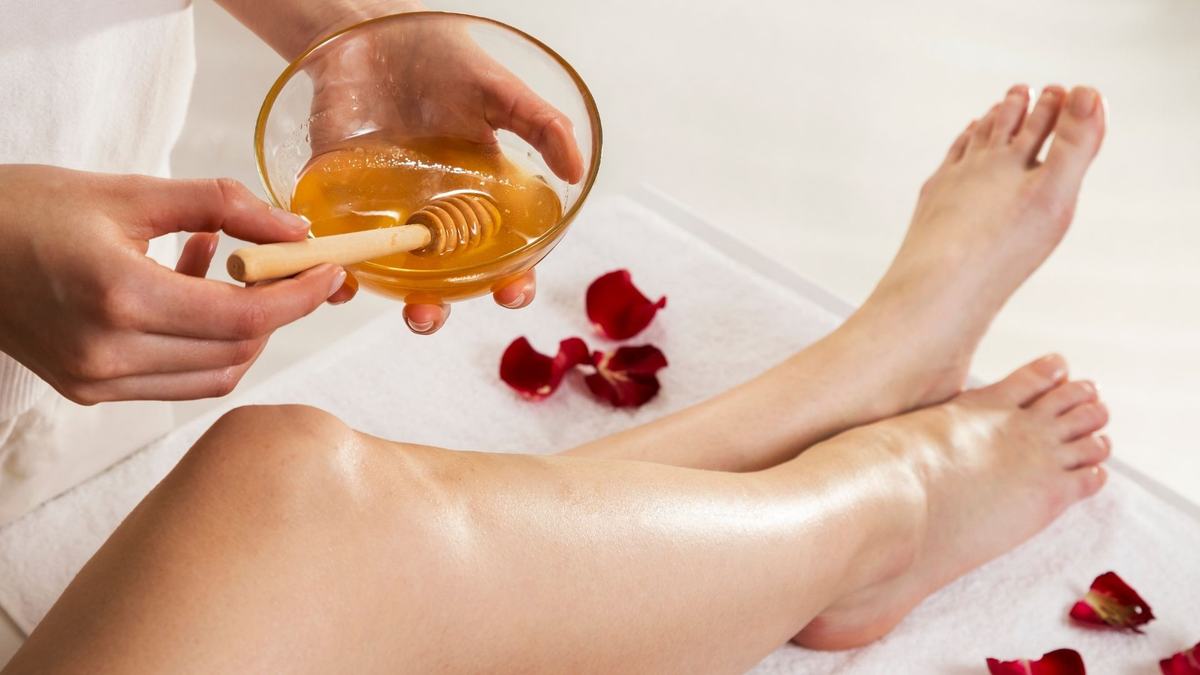
Sugaring reverses waxing. Wax goes on with the direction of hair growth and comes off against it. Sugar paste goes on against the growth and is flicked off with it.
Clean and dry
Both wax and sugar paste grip better on skin with no lotion, no oil and no sweat. We prep the area first.
Paste is worked to temperature
The paste is used at roughly body temperature. Your specialist's hands and the room both change how it behaves — and South Carolina humidity is a real variable, which is why we adjust the consistency by season and by area.
Applied against the growth
The paste is moulded onto the skin in the direction opposite to how the hair lies, so it works down around each shaft.
Flicked off with the growth
A short, quick flick in the direction the hair grows. Because the hair is drawn out along the follicle rather than bent backwards against it, practitioners find it breaks less often. We will be straight with you: that is mechanical reasoning and professional experience, not something anyone has formally measured.
Repeat passes where needed
Sugaring typically takes several passes over the same area, and that is normal rather than a sign something went wrong. Cleveland Clinic notes the same, and explains why it is possible: the cooled paste does not adhere to skin the way wax does. Strip wax, by contrast, generally cannot be reapplied to the same spot.
Why breakage matters at all
It is not pedantry. In a clinicopathological study of 28 women with follicular papules after waxing, biopsies showed foreign-body reactions to hair shafts or keratin in roughly a quarter of cases, which the authors suggested points to retained hair fragments as a mechanism. That study is about waxing and does not test sugaring — but it is why we care about hair coming out whole.
Sugaring vs hard wax vs soft wax
We use all three. They are tools, not teams. Here is the honest comparison.
| Property | Sugar paste | Hard wax | Soft wax |
|---|---|---|---|
| Made from | Sugar, lemon juice, water | Beeswax and rosin, plus additives | Beeswax and rosin, plus additives |
| Temperature | Body temperature | Applied warm | Applied warm |
| Strips | None — removed by hand | None — sets and lifts off | Cloth or paper strip |
| Removal direction | With the growth | Against the growth | Against the growth |
| Repeat passes | Yes, and usually needed | Often fine on small areas | Generally not |
| Cleanup | Warm water | Oil or solvent remover | Oil or solvent remover |
| Contains rosin | No | Yes | Yes |
| Burn risk | Not a concern by hand | Documented complication | Documented complication |
| Best suited to | Sensitive skin, wax reactions, larger areas, shorter regrowth | Bikini, underarms, face, coarse hair | Legs, arms, back, chest — speed over area |
Two claims we will not make
“Painless.” Never. DermNet lists pain as a side effect of epilation including sugaring. Cleveland Clinic puts it well: whether sugaring feels gentler than waxing “is all based on the individual and their pain tolerance.” Many of our clients do find it more comfortable. That is not the same as painless.
“Hypoallergenic.” The FDA is unambiguous that there are no federal standards governing that word — it “means whatever a particular company wants it to mean.” We are not going to use it.
How long your hair needs to be
Sources genuinely disagree here, so here is the reconciled version. Aim for about ¼ inch (6 mm) — two to three weeks of regrowth, roughly a grain of rice. Sugar paste can grip shorter hair than wax can, and on the hand method we can often work with as little as 1/16 inch (about 1.5 mm), which is useful if you have an event sooner than you planned. But ¼ inch gives the most reliable result. Longer than about ¾ inch and we will trim first.
Why appointments land at four to six weeks
Not an arbitrary number, and not a sales schedule. Hair grows in three phases: anagen (active growth), catagen (transition) and telogen (rest). At any moment roughly 10 to 15% of body hair is resting rather than growing.
The key fact, rarely stated correctly online: body hair runs on a far shorter cycle than scalp hair. In the classic measurement study, active growth on the thigh ran around 54 days in men and roughly 22 to 84 days in women; on the upper arm, from about 28 to 151 days depending on sex. Growth rates across body sites range from 180 to 485 micrometres a day, fastest in the armpits.
Because follicles are not synchronised, hairs surface in waves. A single session can never clear an area for good — that is true of every method. Coming back on a regular rhythm catches more of the area in the same wave, which is the real reason regular clients get cleaner results.
What the evidence supports — and what it does not
“Hair grows back finer”
Treat this one carefully. The American Academy of Dermatology describes finer regrowth for laser and makes no such claim for waxing or any mechanical method. Laboratory work on human skin does show that mechanical epilation damages the follicle at a cellular level — thinning of the basement membrane, reduced melanin in the residual follicle, increased keratinocyte apoptosis — but that is cultured tissue over six days, not a client's leg over two years. Meanwhile a clinical study comparing shaving, plucking and waxing on underarm skin found that a single epilation session produced no sustained changes to hydration, barrier integrity, elasticity, roughness or pigmentation.
Here is the version we will stand behind: regrowth after root removal comes back with its natural tapered tip, rather than the blunt cut end shaving leaves — which is genuinely why it feels softer. Long-term clients often describe patchier growth. That is client experience, not a trial. And electrolysis remains the only method the FDA recognises as permanent hair removal.
Ingrown hairs
Ingrown hair and folliculitis are listed side effects of epilation, sugaring included. Nobody can promise you none. Risk is higher with coarse, curly hair and in skin folds, where hairs exit the follicle in every direction. What genuinely reduces them is gentle exfoliation between appointments, loose clothing, moisturising with something non-comedogenic, and not shaving between visits.
Pigmentation, and why we mention it in South Carolina
Post-inflammatory hyperpigmentation happens when inflammation in the epidermis pushes melanocytes to make more pigment. It is more common in darker skin tones, where it tends to be more intense and to last longer, and sunlight makes it worse. If that is your skin, broad-spectrum SPF 50+ on a freshly treated area that will see sun is not a nicety — it is the single most useful thing you can do. Cleveland Clinic specifically lists people whose skin darkens with irritation among those who should approach sugaring cautiously.
Who we cannot sugar, and why
Some of these mean rescheduling. Some just mean we adjust. All of them mean: tell us first.
- Isotretinoin (Accutane) within six months. Non-negotiable. These medications thin the skin, and the AAD's warning is direct — when the wax is removed, the skin could tear. Cleveland Clinic applies the same six months to sugaring specifically. You will find pages claiming waxing is off-limits but sugaring is fine because it is gentler. That is wrong and it is the one myth on this page that could actually hurt you: the risk is mechanical, and mechanical risk does not care what the sticky thing is made of.
- Retinol or prescription retinoids on the area. Stop at least five days before. Some dermatology references advise three to four weeks for prescription strength — if you are on a strong one, tell us and we will talk it through or patch test.
- Acid exfoliants — glycolic, lactic, salicylic. Pause about a week. The FDA's own research found AHAs measurably increase the skin's UV sensitivity, and that it takes roughly a week after stopping for that to return to normal.
- Antibiotics. The AAD advises against waxing while taking them, so we will usually reschedule.
- Recent peels, laser or microneedling. Wait until the skin has fully healed — days for a light peel, one to two weeks for a medium one, two to three for a deep one — and check with whoever performed it.
- Mid-course laser hair removal on the same area. Laser needs the hair in the follicle. Removing it at the root defeats the treatment. Finish the laser course first.
- Sunburn, open wounds, rashes or active infection. Every source we consulted agrees, without exception.
- Keloid-prone skin. Dermatologists advise avoiding unnecessary skin trauma, and there are published cases of keloid scarring after wax epilation. We would want to patch test a small area or refer you.
- Diabetes. Not a blanket no. Dermatologists note that people with diabetes develop skin infections more easily, so we take extra care, especially on the lower legs and feet. Please check with your provider.
- Within two weeks of planned gynecological surgery. ACOG advises against shaving, waxing or lasering in that window.
Before your appointment
- Hair length: about ¼ inch. Trim if it is over ¾ inch, or let us do it.
- Exfoliate 2–3 days before — gently, with a mitt or washcloth. Not the same day.
- Wash and dry the area to remove product and dead skin. Adhesion depends on it.
- Pause retinoids (5 days) and acids (about a week).
- Skip tanning, including sunless tanner, for 24–48 hours.
- If you are worried about discomfort, the AAD suggests an over-the-counter pain reliever or a cold pack about 30 minutes beforehand.
- Wear loose clothing to your appointment. You will want it afterwards.
Aftercare
Expect the area to look red and feel sensitive for a few hours. That is normal. For the first 24 hours:
- No heat — hot baths and showers, saunas, hot tubs.
- No sweat, swimming or soaking. Freshly epilated skin has open follicular openings and a briefly disrupted barrier. Warm shared water is exactly where folliculitis organisms thrive — the CDC's guidance on hot tub rash exists for a reason.
- No sun and no tanning. Sun darkens post-inflammatory pigmentation.
- Loose clothing. Friction is a documented factor in ingrown hairs.
For a few days after that, skip exfoliating scrubs and oils, and use a moisturiser that will not clog pores — heavy occlusive products can trigger a sterile folliculitis of their own. Then resume gentle exfoliation, which is the main thing that prevents ingrown hairs.
Never use a depilatory cream such as Nair on a freshly sugared or waxed area. There is a documented case of a teenager developing severe leg wounds from exactly that sequence, on a cream she had tolerated before — the epilation had disrupted her skin barrier.
When to get it looked at
The AAD's threshold is clear: seek care if redness or swelling lasts more than two days. Call us too — we want to know.
Six things you will read that are not true
| The claim | What is actually the case |
|---|---|
| “Sugaring is painless.” | DermNet lists pain as a side effect of epilation including sugaring, and describes threading as less painful than plucking, waxing and sugaring. |
| “It never causes ingrown hairs.” | Ingrown hair and pseudofolliculitis are listed side effects of epilation, sugaring included. |
| “It is 4,000 years old — Cleopatra used it.” | Sugar refining was known in Sasanian Persia around 460 CE and sugar was confined to the Persian world until after 1000 AD. Sticky-paste epilation is genuinely ancient, but the earliest versions were far more likely honey or resin. Sugaring only entered the dermatology literature in 2001. |
| “It removes hair permanently.” | Electrolysis is the only method the FDA recognises as permanent hair removal. |
| “It cannot burn you because sugar is natural.” | The reason there is no burn concern is temperature, not naturalness — and heated gel-and-strip sugaring is warmer than the hand method. |
| “Waxing is off-limits after Accutane but sugaring is fine.” | Cleveland Clinic applies the six-month rule to sugaring explicitly. The risk is skin fragility and tearing, which is mechanical. |
One more, from the other direction, because it is worth saying plainly: removing pubic hair is not more hygienic. ACOG states there is no medical reason to remove it. Do it because you like how it feels and looks. That is a completely good reason, and it does not need a health justification.
The strongest argument for going to a professional
In a nationally representative survey of 7,570 US adults, a quarter of people who groom reported a grooming-related injury. Women who waxed showed an 89% reduction in repetitive grooming injuries compared with those using blades. That figure is about waxing rather than sugaring, and we are attributing it precisely — but it is the best evidence-based case for putting this in trained hands instead of doing it over a bathroom sink.
Sugaring questions
Is sugaring better than waxing?
Neither is universally better — they are different tools. Sugaring has a real, specific advantage if you react to wax, because it contains no rosin. It grips shorter hair, rinses off with water, and can be re-passed over the same area. Hard wax is often the faster choice on coarse hair in small areas. We use both and will tell you which we would reach for.
Does sugaring hurt less than waxing?
Many clients say it does. Cleveland Clinic's answer is the honest one: it depends on the individual and their pain tolerance. There is no study comparing the two. What is true is that the paste is not hot, and that it adheres far less to skin than wax does.
How long does sugaring last?
Published figures put sugaring around three weeks and waxing anywhere from two to eight, but your own growth cycle and the area matter more than the average. Most of our clients rebook at four to six weeks.
Can I have sugaring on my first ever hair removal appointment?
Yes, and it is a reasonable place to start — particularly if you have sensitive skin or have reacted to wax before. Tell us it is your first time. We will talk you through each step before it happens rather than after.
Do you sugar every area?
We use sugar paste across body and intimate areas. For some services — very coarse hair in a small area, for instance — we may recommend hard wax instead, and we will say why. The choice is always yours.
Is sugaring safe during pregnancy?
There is no medical guidance against hair removal during pregnancy, and it is common. Skin is often more sensitive, so tell us and we will adjust. Check with your provider if you have concerns. One firm rule: not within two weeks of a planned gynecological surgery, per ACOG.
Sources
Every factual claim on this page traces to one of these. Medical and government sources are listed first.
- Cleveland Clinic — What Is Sugaring? (reviewed by Amy Kassouf, MD)
- American Academy of Dermatology — Hair removal: how to wax
- American Academy of Dermatology — How to remove unwanted hair
- American Academy of Dermatology — How to prevent keloid scars
- DermNet — Epilation
- DermNet — Waxing
- DermNet — Rosin and colophony contact allergy
- DermNet — Post-inflammatory hyperpigmentation
- DermNet — Folliculitis
- Cleveland Clinic — Ingrown pubic hair
- Cleveland Clinic — Laser hair removal
- Mayo Clinic — Does shaving make hair grow back thicker?
- ACOG — An OB-GYN’s guide to pubic hair care
- FDA — Alpha hydroxy acids
- FDA — “Hypoallergenic” cosmetics
- CDC — Preventing hot tub rash
- NCBI Bookshelf — Physiology, Hair (StatPearls)
- SC Dept. of Labor, Licensing and Regulation — Board of Cosmetology sanitation rules
- Tannir & Leshin, Dermatologic Surgery 2001 — Sugaring, an ancient method of hair removal
- Lim et al., JAMA Dermatology 2016 — Sugaring: modern revival of an ancient technique
- Truesdale et al., JAMA Dermatology 2017 — Prevalence of pubic hair grooming injuries
- Khanna et al., Int J Dermatol 2014 — Post-waxing folliculitis: a clinicopathological evaluation
- Seago & Ebling, Br J Dermatol 1985 — The hair cycle on the human thigh and upper arm
- Evans et al., Int J Cosmet Sci 2020 — Axillary skin after shaving, plucking and waxing
- Bertolini et al., Int J Cosmet Sci 2023 — Effects of mechanical epilation on human skin ex vivo
- Kang et al., Skin Therapy Letter 2021 — Hair removal practices: a literature review
- Kiene et al., Pediatric Dermatology 2019 — Irritant contact dermatitis after waxing and depilatory cream
- Britannica — Invert sugar
- Encyclopaedia Iranica — Sugar
This page is general information about a cosmetic service, written from published sources. It is not medical advice and it is not a diagnosis. If you have a skin condition, take prescription medication, or are unsure whether hair removal is right for you, talk to your doctor or dermatologist first.
Ready when you are
Book your appointment at Velora
Online booking is open 24/7 through Booksy. Prefer to talk first? Call or message us — we are happy to help you pick the right service.